Sep 11, 2026
How to Choose an Infusion Set Supplier
How to choose an infusion set supplier: check the drop chamber, tubing length and material, flow regulator, needleless port options, packaging, MOQ and documentation before placing an order.
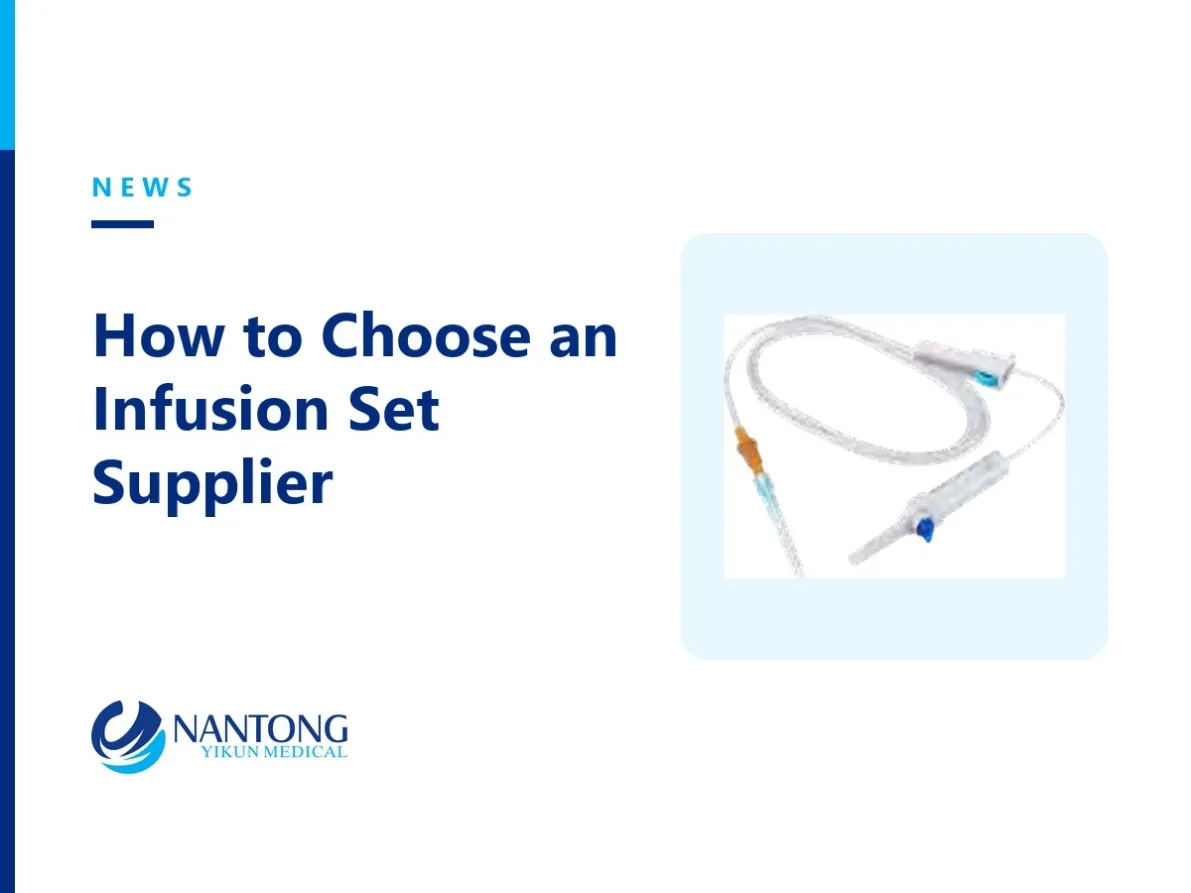
How to choose an infusion set supplier starts with understanding that an IV administration set is a simple device with several real failure points: the spike, the drop chamber, the tubing, the flow regulator, the injection ports and the terminal connector. Every part is described in the catalogue, and every part should be checked on the sample before you commit to a purchase order.
Start from the clinical use. Define the configuration you need before comparing suppliers. A standard adult set usually has a spike, a macrodrip chamber, 1.5 to 2 metres of tubing, a roller clamp and a luer lock connector. Paediatric and precise dosing applications use a microdrip chamber delivering 60 drops per millilitre so rates can be counted accurately, and facilities running secondary medication will ask for Y-site ports and needleless options on the same line.
- Drop chamber and spike: confirm the drops per millilitre specification matches local practice and pumps; macrodrip chambers are typically 10, 15 or 20 drops per millilitre, and microdrip chambers deliver 60 drops per millilitre. A vented spike suits glass infusion bottles, a non-vented spike suits collapsible plastic bags, and some sets include a filtered air inlet.
- Tubing: standard adult sets run 1.5 m or 2 m, so confirm the length the hospital uses. PVC is common, but many markets now require non-DEHP or PVC-free tubing, and the set should be latex-free. Check kink resistance and note the priming volume, which affects drug delivery accuracy.
- Flow regulator: the roller clamp must allow fine, stable adjustment at low flow rates, because poorly moulded clamps drift during infusion. If infusion pumps are not used, ask whether a calibrated dial regulator is available for the same set.
- Ports and connector: note the number and position of injection Y-sites, whether a needleless connector option is offered for line access, and that the terminal connector is the luer lock type most IV lines expect. Rubber injection sites must reseal cleanly after repeated puncture.
Check sterilization, packaging and labelling. Confirm the set is EO sterilised, that each unit is individually packed in a sterile peel pouch, and that the label carries a batch or lot number for traceability, manufacturing and expiry dates, and instructions for use. Custom labelling and multilingual instructions are usually available on request.
- Documentation and traceability: request the specification sheet, sterilization certificate and quality records. A medical device manufacturer is expected to run a certified quality management system such as ISO 13485; ask which market registrations cover the product, what documentation can be supplied, and how a defective batch would be traced and handled.
- Samples: ask for one sample of each configuration you intend to order, then test connector fit, clamp behaviour and flow performance before scaling up.
- MOQ and lead time: agree the minimum order quantity per item and realistic lead times, including how urgent restocks are handled.
Finally, compare total cost rather than unit price. Freight volume, customs paperwork and storage change the landed cost, and a supplier that answers specification questions quickly, keeps batch documentation and ships consistent product is usually worth more than the lowest quote. Choosing an infusion set supplier is ultimately a judgement about consistency, not just price.
Related products: browse Disposable Infusion Sets at https://www.yikunmed.com/products/disposable-infusion-set.
For quotations, samples and technical specifications, contact the YIKUN Medical team at https://www.yikunmed.com/contact-us.