Sep 11, 2026
Luer Lock vs Luer Slip Syringe: What's the Difference?
Luer lock vs luer slip syringe connections compared for medical procurement: friction-fit slip tips versus threaded lock tips, typical clinical uses, component compatibility and what to verify before
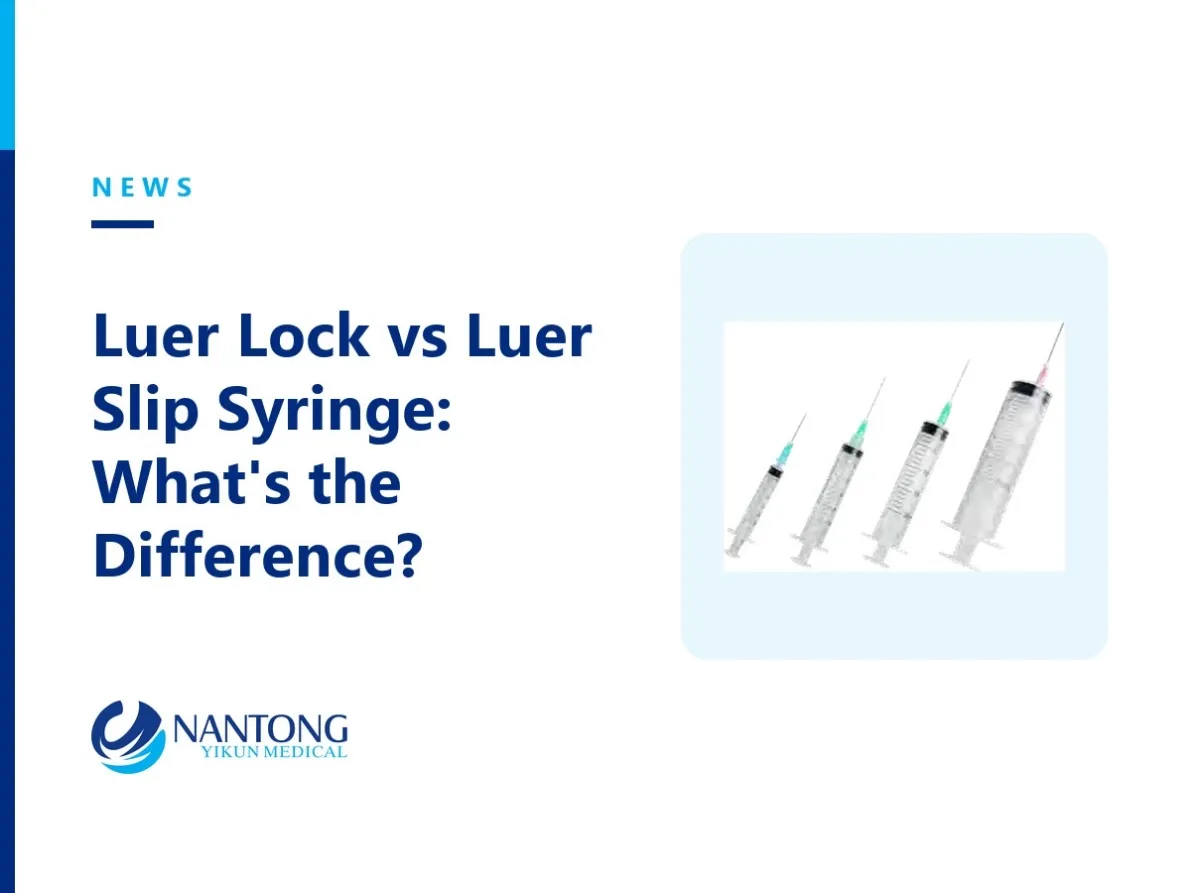
Luer lock vs luer slip syringe connections are the two ways a syringe tip can hold a needle, IV line or extension set, and the difference is simple: a slip tip holds the mating part by friction fit, while a lock tip adds a threaded collar that screws the two components together. The choice decides how securely parts stay attached during use, so it pays to specify it correctly in tenders and stock lists.
A luer slip tip is a smooth, gently tapered cone built to the standard luer taper, and the needle hub or line connector is simply pushed onto it. Friction holds the joint together. Attachment is fast and the profile is compact, but the connection can separate if it is pulled sideways or pushed under backpressure, so slip is chosen where quick connect and disconnect matter more than holding force.
A luer lock tip has the same tapered cone surrounded by a collar with an internal thread. The mating component carries matching lugs, and a short twist of the collar locks the two together. The connection resists axial pull and working pressure, which is why lock is the standard choice for anything that stays attached to a line or remains under pressure.
- Fit: slip presses on, lock screws on with a short twist.
- Security: slip relies on friction and can come loose under tension, lock holds mechanically and will not pop off.
- Speed: slip connects in one push, lock takes one extra twist.
- Compatibility: a lock syringe accepts both slip-hub and lock-hub needles, while a slip syringe accepts only slip-hub needles.
Typical uses follow directly from these properties. Luer slip is common for routine subcutaneous and intramuscular injections, where the needle is attached and used immediately. Luer lock is preferred for IV push medication and for connecting syringes to IV administration sets, extension lines and three-way stopcocks, and anywhere a connection stays assembled during infusion or patient transport.
Luer lock vs luer slip syringe compatibility is helped by standardisation. Both tips follow the same international dimensional standards for luer connectors, ISO 594 and, for newer devices, ISO 80369-7, so components from different manufacturers generally interchange within the same style. Verify with physical samples anyway, because plastic tolerances and thread quality vary between factories.
Material and finishing points apply to both types. Plunger seals are latex-free, syringes are EO sterilised and individually packed with a stated shelf life, and tip style and capacity should be separate line items in your order so the warehouse picks exactly what clinicians expect. Needle gauge and length are specified independently of the tip style.
For a distributor, the practical question is the mix of lock and slip in your demand. IV therapy, anaesthesia and critical care buy mostly luer lock; vaccination and outpatient injection programmes often use slip with separate or attached needles. Carry both, and ask the supplier for specification sheets and pre-shipment samples before committing to container volumes. Also confirm the sizes, needle configurations and packaging variants you need, because each variant adds a separate SKU to manage.
Which should you choose? If the syringe connects only to a needle for a single injection, slip is adequate and cheaper. If it connects to a line, a pump, a stopcock or anything pressurised, choose luer lock. When in doubt, stock lock, because a lock syringe still accepts slip-hub needles.
Related products: browse Disposable Syringes at https://www.yikunmed.com/products/disposable-syringe and IV Cannulas at https://www.yikunmed.com/products/iv-cannula.
For quotations, samples and specification sheets, contact the YIKUN Medical sales team at https://www.yikunmed.com/contact-us.